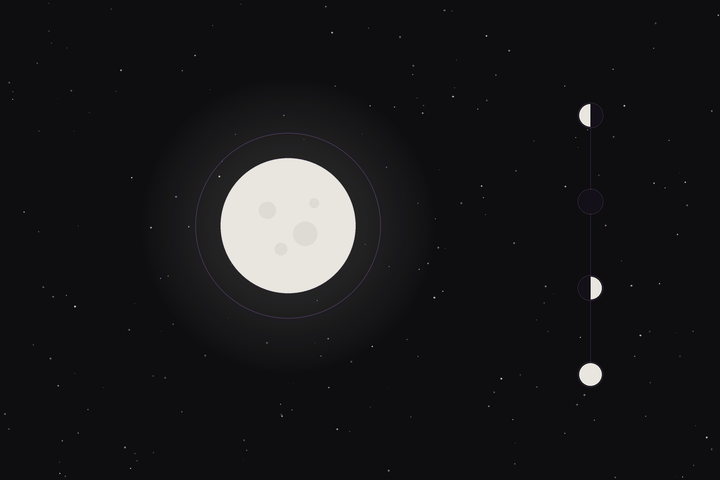
The moon runs through eight phases on a loop of about 29.5 days, swelling from dark to full and shrinking back again. Each phase has its own look, its own pace and, in moon-led traditions, its own supposed meaning. Here are the eight phases of the moon in order, what each one actually looks like, and the energy it is said to carry.
Want tonight's exact moon phase?
Our free moon phase tool shows you exactly where the moon is right now, so you can match tonight's ritual to the real sky, not a guess.
Check tonight's moon phaseWhy the Moon Has Phases
The moon makes no light of its own. It just reflects the sun, like a very large rock with good PR. As it orbits the Earth, the angle between the sun, Earth and moon shifts, so we see more or less of its lit half. That slow change, from a dark new moon to a bright full moon and back, is the cycle of phases. One full loop, a lunation, takes roughly 29.5 days.
The 8 Moon Phases in Order
Here they are in sequence. Each links to its full meaning and the rituals traditionally pinned to it.
- 1. New Moon (0% lit): beginnings, setting intentions and planting seeds.
- 2. Waxing Crescent (a growing sliver): taking the first steps and building momentum.
- 3. First Quarter (half lit on the right): decisions, action and pushing through resistance.
- 4. Waxing Gibbous (almost full): refining, adjusting and staying patient.
- 5. Full Moon (100% lit): culmination, release and gratitude.
- 6. Waning Gibbous (just past full): gratitude, sharing and the first release.
- 7. Last Quarter (half lit on the left): letting go, forgiveness and clearing space.
- 8. Waning Crescent (a fading sliver): rest, surrender and quiet reflection.
Waxing and Waning
The cycle has two halves. The waxing half runs from the new moon to the full moon, when the light grows: traditionally the building, drawing-in, get-things-done stretch. The waning half runs from the full moon back to the new moon, when the light fades: the releasing, clearing and resting stretch. If you forget everything else in this post, keep this: waxing is for calling in, waning is for letting go.
How Long Each Phase Lasts
The four main phases, new, first quarter, full and last quarter, are each a single exact moment, though we tend to feel their mood for a day or two either side. The four in-between phases, the crescents and gibbous moons, each stretch across roughly a week while the light grows or shrinks.
Working With the Moon's Phases
Plenty of people like to run their month a little more in step with the moon: setting intentions at the new moon, taking action as it waxes, releasing at the full moon and easing off as it wanes. To go deeper, read the spiritual meaning of the moon, explore moon symbols and their meanings, or gather for a moon circle.
Frequently asked questions
The eight phases in order are: new moon, waxing crescent, first quarter, waxing gibbous, full moon, waning gibbous, last quarter and waning crescent. The cycle then begins again.
One complete cycle, from new moon to new moon, takes about 29.5 days, known as a lunation. The four main phases each mark a moment, while the crescent and gibbous phases each last about a week.
Waxing means the lit part is growing, from new moon to full, a time for building and drawing in. Waning means it is shrinking, from full back to new, a time for releasing and rest.
Broadly: new moon for beginnings, waxing for building, full moon for culmination and release, and waning for letting go and rest. Each phase has its own page with the full meaning.
The new moon is the traditional time to set intentions and plant seeds for the cycle ahead, while the full moon is favoured for release and gratitude.