For as long as people have looked up, the moon has stood for something we feel but cannot quite name. It is the light that changes, the face that turns away and returns, the one steady fixture of the night sky. Across centuries and cultures, the moon has carried a consistent cluster of meanings: intuition, emotion, the inner life, and the slow turning of cycles. None of this is doctrine. It is the accumulated language of people trying to make sense of their own depths by staring at a rock in the sky. This is what the moon has come to mean, and how you might work with that meaning without pretending it is more certain than it is.
Want tonight's exact moon phase?
Our free moon phase tool shows you exactly where the moon is right now, so you can match tonight's ritual to the real sky, not a guess.
Check tonight's moon phaseWhat the Moon Represents Spiritually
In most traditions, the moon is associated with feminine energy. This is less about gender than about a quality: receptive, reflective, drawing inward rather than pushing outward. Where the sun is cast as the active, illuminating principle, the moon is its counterpart, the part of us that listens, absorbs and waits.
The moon is also the emblem of intuition. Its light is borrowed, soft and indirect, which made it a natural symbol for the kind of knowing that does not arrive through argument. When people talk about a gut feeling or a sense they cannot justify, they are describing lunar knowledge: quiet, certain, and stubbornly resistant to proof.
Then there is the matter of cycles. The moon never holds still. It waxes to fullness and wanes to dark, every month, without fail. For anyone watching, it becomes a model of how things move: nothing is permanent, nothing is final, and every emptiness is followed by a return. Tied to this is the moon's link to the subconscious, the hidden tides beneath waking thought. Dreams, instincts and the things we only half admit to ourselves all belong, symbolically, to the moon.
The Moon and Your Emotions
The clearest reason the moon became a symbol of feeling is physical. The same gravitational pull that moves the oceans has, for most of human history, seemed to move us as well. We talk about emotional tides, about being swept up, about feeling low. The language is lunar before we even notice it.
Working with the moon emotionally does not require believing it controls your mood. It is enough to use the moon as a prompt: a regular nudge to check in with how you actually feel rather than how you think you should. The full moon, bright and exposed, tends to be associated with heightened emotion and clarity, when whatever has been simmering rises to the surface. The dark of the new moon, by contrast, is linked with rest, privacy and the quiet that comes before something begins. Whether or not the moon causes any of it, treating its phases as markers can make your own emotional rhythm easier to see.
The Spiritual Meaning of Each Moon Phase
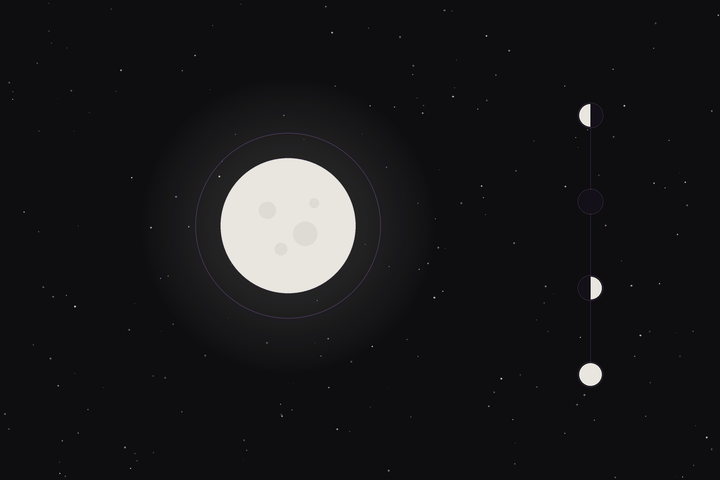
Each phase of the lunar cycle has gathered its own associations. The order runs continuously from dark to dark, and you can follow the full sequence in our guide to the moon phases. Here is the energy each phase is traditionally given, in a single line.
| Phase | Traditional energy |
|---|---|
| New moon | Beginnings, intention, planting the seed |
| Waxing crescent | Hope, first steps, gathering momentum |
| First quarter | Decision, effort, pushing through resistance |
| Waxing gibbous | Refinement, patience, almost there |
| Full moon | Fullness, clarity, celebration and release |
| Waning gibbous | Gratitude, sharing, drawing the lesson out |
| Last quarter | Letting go, forgiveness, clearing space |
| Waning crescent | Rest, surrender, the quiet before renewal |
How to Work With the Moon's Energy
The simplest and most durable practice follows the shape of the cycle. At the new moon, when the sky is darkest, you set intentions: name what you want to begin or grow, write it down, and hold it lightly. As the moon swells toward full, you act and tend to what you have planted. At the full moon, you mark whatever has come to fruition, and you release what is no longer serving you, the resentments, habits or fears you would rather not carry into the next cycle.
This is not magic in the cause and effect sense. It is structure. Using the moon as a calendar for reflection gives your intentions a beginning and your letting go an ending, which is more than most of us manage left to our own devices. If you would like a step by step way in, our new moon rituals guide is written for exactly that.
The Moon in Astrology and Tarot
The moon runs deep through both astrology and tarot. In astrology, your moon sign is said to describe your inner emotional world, the private self beneath the personality your sun sign shows to everyone else. It is often called the most intimate point in a chart. We unpack this further in our piece on the moon in astrology.
In tarot, the moon appears as a card of dreams, illusion and the unconscious. It speaks of things half seen, of feeling your way through uncertainty rather than demanding clarity that is not yet on offer. For a fuller reading of its imagery and meaning, see our guide to the Moon tarot card.
Is the Moon's Power Real?
Time to be honest. There is no solid scientific evidence that the moon shapes human mood, sleep or behaviour the way folklore insists. The studies that went looking for a lunar effect have largely come up empty. The moon does not pull on your body the way it pulls on the sea, no matter how the full moon feels on a bad night.
What the moon does offer is real in a different sense. It is a reliable, visible rhythm in a life that often has none. It gives you a reason to pause, to reflect, to begin and to release on a regular cadence. The meaning is something you bring to it, not something it broadcasts to you. For many people that is plenty, and arguably it is the truest kind of power the moon has ever had.
Frequently asked questions
The moon symbolises intuition, feminine and receptive energy, emotion, and the cycles of beginning and release. Its changing light made it a natural emblem for the inner life and for the rhythm of renewal.
The moon is traditionally seen as receptive and reflective, drawing inward rather than acting outward, which many traditions describe as feminine. It is paired with the sun as its active counterpart, balancing the two principles.
There is little scientific evidence that the moon directly changes mood or behaviour. Its value is symbolic: its phases offer a regular prompt to check in with how you genuinely feel and to notice your own emotional rhythm.
The new moon is traditionally used for setting intentions, as the dark sky marks a fresh start. The full moon is then used to celebrate progress and release what is no longer needed before the cycle begins again.
In tarot the Moon card represents dreams, illusion and the unconscious. It points to things half seen and encourages you to move through uncertainty by trusting your instincts rather than waiting for full clarity.