Once a month the Moon goes dark. For a night or two it slips out of the sky entirely, and then the first thin crescent returns. For thousands of years people have treated that quiet turning point as a cue to begin again, to set down what is finished and name what they would like to grow.
Want tonight's exact moon phase?
Our free moon phase tool shows you exactly where the moon is right now, so you can match tonight's ritual to the real sky, not a guess.
Check tonight's moon phaseThat is the whole idea behind a new moon ritual. You do not need to be an astrologer or own a single crystal to try one. This beginner's guide covers what the new moon actually is, a simple ritual you can do tonight, how to write intentions that mean something, and an honest look at what the science does and does not say.
What Is a New Moon?
The new moon is the phase when the Moon sits between the Earth and the Sun. According to NASA, this is "the invisible phase," with the lit side of the Moon facing the Sun and the dark side turned toward us, which is why we cannot see it. A few days later the waxing crescent appears, and the cycle builds toward the full moon before fading again.
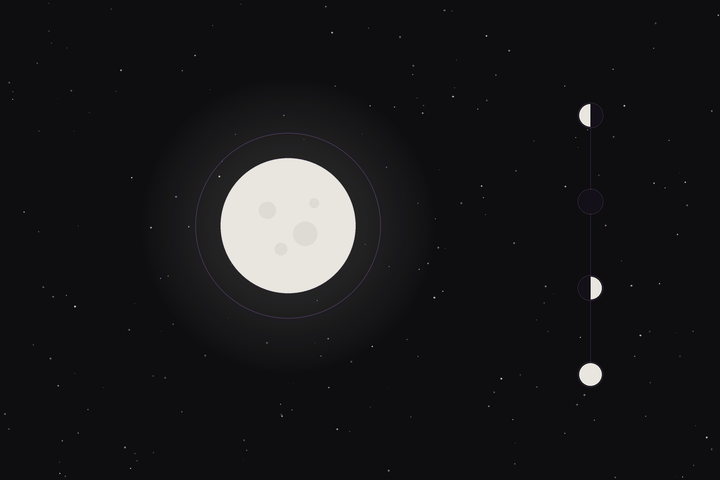
That whole cycle, from one new moon to the next, takes about 29.5 days and moves through eight phases in order: new moon, waxing crescent, first quarter, waxing gibbous, full moon, waning gibbous, third quarter and waning crescent. The new moon is the seed of that cycle, the dark, fertile starting point, which is exactly why it has long been tied to fresh beginnings.
What the New Moon Represents
Across many cultures the new moon has marked the start of a new month; lunar and lunisolar calendars still set their months by it. Symbolically it carries that same meaning of beginnings: a clean page, a quiet invitation to plant something and let it grow over the weeks that follow.
In modern moon practice, the new moon is the time to set intentions rather than release them. Astrologer Yasmin Boland, whose book Moonology introduced lunar rituals to a wide audience, describes the new moon as the most powerful moment of the month to plant the seeds of what you want to call in.
New Moon vs Full Moon Rituals
It helps to know where the new moon sits in the rhythm of the month. The two turning points do opposite work:
- New moon: begin. Set intentions, start projects, plant seeds, imagine what you want more of.
- Full moon: release. Give thanks, let go of what is finished, notice what has come to light, and clear space.
If you are only going to mark one each month, the new moon is the natural place for a beginner to start, because intention-setting gives you something to carry forward.
How to Prepare for a New Moon Ritual
You need very little. A candle and something to write with is genuinely enough. If you want to make more of it, gather a journal, a candle, and any crystals or oils you love, but treat those as welcome extras, never requirements.
A few pointers on timing and setting:
- When: within a day or two of the new moon, ideally in the evening when you can be quiet and undisturbed.
- Where: a small, calm space: a cleared table, a corner of the bedroom, anywhere you can sit without interruption.
- How: turn off your phone, lower the lights, and give yourself ten unhurried minutes. The stillness is half the ritual.
A Simple New Moon Ritual for Beginners
Here is a complete ritual you can do tonight, start to finish.
- Create a little calm. Tidy your space, light a candle, and take a few slow breaths until you feel settled.
- Reflect. Ask yourself what you would like the coming month to hold. What do you want more of? What are you ready to begin?
- Write your intentions. Put two to four down on paper, in the present tense, as if they are already on their way (more on this below).
- Read them aloud. Saying them softly makes them feel real and fixes them in your mind.
- Sit for a moment. Picture each intention quietly taking root. You might hold a crystal here, or simply rest your hands in your lap.
- Close the ritual. Blow out the candle (or let it safely burn down) and keep your list somewhere you will see it through the month.
That is the whole thing. It is meant to be simple, and it works just as well in ten minutes as in an hour.
How to Write New Moon Intentions
The writing is the part that carries the most weight, so it is worth doing with a little care. Astrologer Jan Spiller built an entire practice of new moon "power wishes" in her book New Moon Astrology, and her advice still holds: be specific, and frame each wish positively.
- Keep it to a few. Two to four intentions are easier to hold than a long list.
- Write in the present tense. "I am..." or "I have..." rather than "I want...," which keeps you in wanting.
- Be specific. "I move my body three mornings a week" lands better than "I am healthier."
- Say what you do want, not what you are trying to avoid.
The Lunar Abundance practice created by Ezzie Spencer, PhD, in her book of the same name, frames this even more gently, as self-care timed to the Moon, rather than a list of demands. Whichever tone suits you, the point is the same: a few honest lines, written with attention.
Ways to Deepen Your Ritual
Once the simple version feels familiar, you can add to it. None of these are necessary, but each can make the evening feel richer:
- Crystals. Hold a stone as you set your intentions, or leave your crystals on the windowsill to bathe in the new moon. It is a natural moment to cleanse and charge them, and your star sign crystal is a lovely one to hold.
- Scent. A little lavender or another calming essential oil helps signal to your body that it is time to slow down.
- Tarot or oracle cards. Pull a single card to reflect on for the month. If you are new to it, our guide to the Major Arcana is a gentle place to start.
- Moon water. Leave a covered jar of water out overnight to use in the month ahead.
- A ritual bath. A warm bath before or after, to mark the threshold.
If you would like a smaller, everyday version of this kind of practice, our simple evening ritual works beautifully on any night of the month.
When Is the Next New Moon?
The new moon arrives about every 29.5 days, marking the start of a fresh lunar cycle. Many people like to set their intentions within roughly 24 to 48 hours of the new moon, while the mood feels quiet and new. If you are unsure where the cycle sits right now, check the moon phase today and plan your ritual around it.
Your New Moon Ritual Checklist
- Find a quiet space where you can settle without interruption.
- Light a candle to mark the start of your ritual.
- Have a journal and pen ready.
- Reflect on what you would like to invite in over the coming cycle.
- Write your intentions in the present tense, as though they are already unfolding.
- Speak your intentions aloud to give them weight.
- Release any expectation of how or when they arrive.
- Revisit your intentions at the full moon to notice what has shifted.
Go Deeper: Manifestation, Intentions and Energy
Once you feel at home with the basics, you can explore each thread on its own. Read more on new moon manifestation to work with the cycle as a creative practice, on new moon intentions to refine what you ask for and how you word it, and on new moon energy to understand the quiet, inward mood this phase is often associated with.
New Moon Rituals for the New Year and Fresh Starts
The first new moon of the year, or any new moon that lands at a turning point, is a beautiful time for a fresh start. The practice is the same as any new moon ritual, but the intentions carry extra weight: a clean slate, a new chapter, a whole year ahead to shape. Set your intentions for the months to come, write them in the present tense, and revisit them through the year. A new moon in early January, on a birthday or at the start of a new season makes a natural reset point.
Does the Moon Really Affect Us?
Time for some honesty. Large studies have found little reliable evidence that the Moon's phase changes our mood or behaviour. One study of nearly 6,000 children across five continents concluded that "the moon does not seem to influence people's behavior", and the Cleveland Clinic notes that research on the Moon and our minds is conflicting and inconclusive. Sleep is the one area with a real signal: a controlled lab study by Christian Cajochen and colleagues in Current Biology found slightly poorer sleep around the full moon, though later studies have been mixed.
So the value of a new moon ritual is not some hidden lunar force tugging at you. It is the rhythm it gives you: a dependable, monthly prompt to pause, reflect and reset your intentions. The Moon is a beautiful, reliable clock, and honestly that is more than enough reason to follow it.
Begin Where You Are
After years of marking the new moon, I am convinced the ritual matters far less than simply showing up for it. Your first new moon ritual does not have to be perfect. Light a candle, write a few honest lines, and let that be enough. Do it again next month, and the one after, and it slowly becomes a practice you can lean on. When you are ready to bring crystals into it, our guide to crystals for every zodiac sign will help you choose your first.
Keep Exploring
Frequently asked questions
A new moon occurs about every 29.5 days, which is the length of one full lunar cycle. That works out to roughly one new moon each calendar month, and occasionally two in a single month.
Many people choose to set their intentions within about 24 to 48 hours of the new moon, while the energy feels fresh and quiet. There is no single correct moment, so work with whatever timing suits you.
Very little. A quiet space, a candle, and a journal and pen are enough to begin. Some people add crystals or incense, but these are optional touches rather than requirements.
A new moon ritual is best thought of as a reflective practice rather than a guaranteed outcome. Many people find that writing and speaking their intentions helps them feel clearer and more focused on what matters.